I previously noted that I think the absence of judicial experience is not a drawback (May 11). ABC News reports that in a speech in Washington, Justice Antonin Scalia, a conservative hero, stated that he is "happy" that Kagan is not a judge. The ABC report can be found here.
Friday, May 28, 2010
Justice Scalia: "Happy" Kagan Is Not a Judge
One of the criticisms of President Obama's nomination of Solicitor General Elena Kagan to the United States Supreme Court, particularly from conservative quarters, focuses on the nominee's lack of judicial experience.


Wednesday, May 26, 2010
Post-Judgment Interest in Diversity Actions
Under New York law interest on judgments secured in state court runs at the rate of 9% per annum. CPLR § 5004. But what is the rate of interest when a judgment is secured in a diversity action in a federal court located in New York? Ordinarily, interest on a federal judgment is based on the yield on a Treasury note, 28 U.S.C. § 1961(a), a rate which these days is considerably lower than 9%.
In FCS Advisors, Inc. v. Fair Finance Co., Inc., the plaintiff brought a diversity suit in the United States District Court for the Southern District of New York and was awarded summary judgment for $1.5 million. The District Judge awarded prejudgment interest at the New York rate of 9%. He also awarded post-judgment interest at the New York rate of 9%, and not at the lower federal rate, because the parties' contract had a choice-of-law provision that the contract would be governed by New York law.
The United States Court of Appeals for the Second Circuit reversed the award of post-judgment interest at the New York rate, and directed that the federal interest rate applies. The Circuit made several points.
First, in diversity actions state law governs the award of prejudgment interest.
Second, in diversity actions the federal rate applies to post-judgment interest.
Third, parties by contract can agree in "clear, unambiguous and unequivocal language" that a different rate of post-judgment interest will apply to federal judgments.
Fourth, the standard choice-of-law provision of a contract will not alter the federal rate of post-judgment interest because it does not contain "clear, unambiguous and unequivocal language" expressing an intent that a rate other than the federal rate will apply post-judgment. The parties must be more precise. The decision can be found here.
Friday, May 21, 2010
Kagan Confirmation Hearings to Begin
Patrick Leahy, chairman of the United States Senate Judiciary Committee, has announced that Committee hearings to consider the nomination of Solicitor General Elena Kagan to the United States Supreme Court will begin on June 28.
Senator Leahy's announcement noted that the Committee hearings last year on the nomination of Sonia Sotomayor began 48 days after the nomination was made by President Obama. The hearings on Elena Kagan will begin 49 days after the President's nomination. Senator Leahy's full statement can be found here.
The Senate Committee has also released the bipartisan questionnaire submitted to Solicitor General Kagan and her responses to the questionnaire. The questionnaire, and all the supplemental material transmitted to the Committee, can be found here.
Wednesday, May 19, 2010
"Meet the Justices": Appellate Division, Second Department
Yesterday afternoon I was a member of a three-lawyer panel which quizzed eight Justices of the Appellate Division, Second Department, on appellate practice as part of the "Meet the Justices" program sponsored by the Committee on Courts of Appellate Jurisdiction of the New York State Bar Association. About 130 attorneys attended the two hour program which was held in the Second Department's courtroom in Brooklyn.
The questions covered a wide range of topics from brief writing and oral argument, to the internal operations of the Court. Depending on the year in question, the Second Department is either the busiest appellate court in the United States, or among the three busiest (the other two are in California and Texas). Of particular interest to me were the following points made by the judges.
First, all of the Justices present agreed with Presiding Justice A. Gail Prudenti that oral argument is important (a topic I have commented on before). A number of the Justices stated that while half of the cases are relatively easy to resolve, the other half are "close," and in these close cases oral argument is important in resolving the matter. There was agreement among the judges that no appellant should forego oral argument, and agreement that when an attorney does not appear for oral argument this sends a message to the Court that the attorney thinks little of his client's case.
The Justices also emphasized the importance of counsel's knowledge of the record at oral argument ("We should not know the record better than you do"). From personal observation I can confirm that the Justices on the Second Department come onto the bench with a thorough understanding of the record.
Second, with respect to brief writing, all of the Justices criticized the use of footnotes as a distraction ("If it is important enough to put it in the brief, it is important enough to put it in the body of the brief"). Because most cases are fact driven, a detailed statement of the facts is important, but they criticized the extended discussion of facts not relevant to the legal issues raised in the brief. They emphasized that an appellate brief is not a law review article, and that "string citations"--citing many cases for the same legal proposition--have no place in a brief. They all thought a brief should contain a preliminary statement setting out the "nub" of a party's contentions.
Third, and most interesting to me, was the acknowledgment that prior to oral argument Justices may discuss among themselves a case (or more) on the forthcoming calendar. I had seen an interview with Justice John Paul Stevens in which he stated that the Justices of the United States Supreme Court do not discuss cases prior to oral argument, and that the first sense he has of his colleagues' views comes at oral argument. That is not the practice in the Second Department.
Fourth, Presiding Justice Prudenti indicated that there is a greater willingness now than in the past for the Court to grant leave to appeal to the New York Court of Appeals in a civil case. The perception among members of the Bar is that the Appellate Divisions prefer to let the Court of Appeals determine its own calendar rather than have an Appellate Division send the high court a case. Justice Prudenti's remarks suggest that her Court may now be more open to a leave application.
Tuesday, May 11, 2010
A New Supreme Court Justice
President Obama's nomination of Elena Kagan to the United States Supreme Court has raised the complaint in some quarters that she is not qualified to sit on the Court because she has no judicial experience. The complaint is without merit.
A quick look back at the 20th century shows that the Supreme Court was the first judicial job for the most influential Justices: Louis Brandeis, Felix Frankfurther, William O. Douglas, Hugo Black, Robert Jackson, Earl Warren, and William Rehnquist immediately come to mind. While Benjamin Cardozo arrived at the Supreme Court after many years on the New York Court of Appeals, he began his tenure on the Court of Appeals after only a very brief stint on a Manhattan trial court.
The United States Supreme Court is a policy making body, and it does not appear that prior judicial experience makes one better equipped to set policy than being a former practicing lawyer (Brandeis), a former governor (Warren), a former law professor and chair of the Securities and Exchange Commission (Douglas), a former United States Senator (Black), or a former member of the Department of Justice (Rehnquist). The Supreme Court's recent decision in Citizen United v. Federal Election Commission which declined to limit corporate contributions to elections was a policy determination by five members of the Court on the reach of the First Amendment. The prior judicial experience of the five-person majority did not lead to the result; it was their policy predilections.
It can be helpful for one or more members of a high court to have had prior courtroom experience as a trial judge or a trial attorney. For example, Justice Sonia Sotomayor's experience as a United States District Court Judge is valuable in bringing to the Court an understanding of how particular procedural rulings will play out at the trial level. But I do not think her prior judicial experience necessarily makes her better equipped to address the broad constitutional policy questions with which the Supreme Court deals.
In sum, I am not fazed in the least about the absence of judicial experience in Elena Kagan's resumé.
Finally, much has been made of the fact that with the retirement of Justice Stevens (who attended Northwestern Law School), and the elevation of Kagan to the Court, all the Justices will have graduated from Harvard or Yale law schools. (While Justice Ginsburg did attend Harvard, she actually graduated from Columbia Law School.)
This just tells me that smart, ambitious people have a keen understanding of where political and legal power resides, a notion best captured by the title of the autobiography of westerner Justice Douglas, Go East, Young Man. I would be concerned if graduation from a small circle of schools was producing a single mold of thought, but it is not. The current Harvard and Yale graduates on the Court are on both sides of the ideological divide.
More interesting is that if Elena Kagan is confirmed there will be four New Yorkers on the Court: Chief Justice Roberts (Buffalo), Justice Ginsburg (Brooklyn), Justice Sotomayor (the Bronx), and Kagan (Manhattan). And while Justice Scalia was born in New Jersey, he was raised in Queens from the age of six. Maybe more important than law school is the New York water.
Tuesday, May 4, 2010
The Supreme Court, Architecture, and the Law
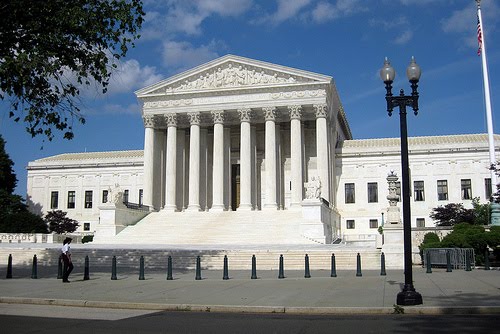 Yesterday the United States Supreme Court issued a statement that visitors to the Supreme Court Building in Washington will no longer be able to enter the building through the front entrance at the top of the stairs, although they will be able to exit the building through the front door. The statement indicates that the change has been made for security reasons.
In response, Justice Breyer issued a "Statement Concerning the Supreme Court's Front Entrance" in which Justice Ginsburg joined. Justice Breyer expresses "regret" at the closing of the Court's front entrance, and writes that the change defeats the vision that architect Cass Gilbert had for the building and the feeling he wanted to instill in visitors.
I recommend reading Justice Breyer's full statement. It reflects a sensitivity to a renowned architect's vision, and, more generally, the role that architecture plays in symbolizing what we expect from our halls of justice. The statement can be found here.
Tuesday, April 20, 2010
SEC v. Goldman Sachs: Read the Complaint
The big financial news the past few days has been the civil securities fraud suit filed by the Securities and Exchange Commission against Goldman Sachs in the United States District Court for the Southern District of New York.
The heart of a securities fraud suit is the claim that there was a "material" misstatement of fact or a "material" omission of fact. I have no opinion whether Goldman Sachs is liable, but I do think the press has made a simple situation appear to be oh-so-complicated.
The background is simple. In 2007 a hedge fund Paulson & Co. Inc. wanted to make a bet that the subprime residential mortgage market would collapse. It put together a portfolio of subprime residential mortgage market securities it believed would lose value and it asked Goldman Sachs to, in effect, find investors who would bet that the value of the securities would rise. The bet would be made by using a "synthetic collateralized debt obligation" (CDO)--the sophisticated financial instrument touted in the press.
The SEC claims that in marketing the bet Goldman Sachs did not disclose that Paulson was deeply involved in selecting the securities in the portfolio, and that Goldman took steps to conceal Paulson's involvement by having it appear that an impartial third party had independently selected the securities for the bet. The value of the portfolio did fall. Paulson made about $1 billion while those on the other side of the bet lost that amount.
Paulson's economic interests were, of course, adverse to those who would bet that the value of the securities would rise. In the SEC's view Goldman is guilty of a material omission of fact because it did not disclose to those betting the securities would rise that the portfolio was selected with the deep participation of the party who would bet that the value of the portfolio would decline. Whether Goldman was required to make this disclosure, and whether this failure to disclose is a material omission, will doubtless be the cause of multiple court filings by the SEC and Goldman's attorneys.
It has already been the source of endless press comment by academics and securities attorneys. But all the discussion regarding whether disclosure of the identity of the party on the other side of this "sophisticated" bet was required, has, in my opinion, obscured the SEC's second claim: Goldman affirmatively misled the parties by misstating Paulson's role in the transaction to suggest that Paulson had an economic interest in seeing the portfolio value rise.
Thus, for all the trumpeting in the press about an impenetrable, sophisticated transaction, in the end it boils down to a claim of a garden variety fraud: Goldman misstated the true nature of Paulson's involvement, thereby misleading those who bet the value of the securities would rise. Paragraphs 44 through 51 of the SEC complaint are, in my opinion, the practical heart of the matter. The complaint can be found here.
Goldman will undoubtedly deny it misled anyone. But it is one thing to argue to a jury that a party had no obligation to disclose certain information. It is an altogether different matter to acknowledge that one did say something, but it was not misleading. Juries understand the difference, and if the case goes to trial the outcome will turn on whether a jury believes Goldman affirmatively misled those who lost the bet.
Arguing Another Attorney's Appeal
Last month I reported that I had again orally argued an appeal in which I did not draft the briefs. In a serious personal injury matter, the defendant appealed the denial of summary judgment by Supreme Court, New York County.
Plaintiff's counsel asked me to appear for oral argument before the Appellate Division, First Department. I did so, and I am pleased to report that in Tomaino v. 209 East 84th Street Corp. the Appellate Division affirmed the denial of summary judgment. The opinion can be found here.
While there are those who may disagree, I continue to believe that oral argument is important. It is the only opportunity counsel has to answer questions judges may have after reading the briefs and the record. After reading the briefs judges go on the bench inclined to decide a case a particular way. Different appellate judges have told me that oral argument has changed their minds 5% to 15% of the time. This is not an opportunity to pass up.
Thursday, April 1, 2010
Supreme Court: Effective Assistance of Counsel and Deportation
In a much awaited decision, the United States Supreme Court ruled yesterday that the constitutional right to the effective assistance of counsel in criminal cases requires that defense counsel advise a noncitizen defendant that if he pleads guilty the plea carries the risk of deportation from the United States. The decision, Padilla v. Kentucky, can be found here.
In the past, many courts across the country had taken the view that because the deportation consequence of a guilty plea is a matter "collateral" and not directly related to the criminal case, defense counsel had no obligation to advise his client of the possibility, or in many instances, the certainty, of deportation.
Padilla concludes, however, that because deportation is an "integral part" of the penalty a defendant who pleads guilty faces, and because deportation is "intimately related to the criminal process,'' the collateral versus direct distinction is not appropriate in the deportation context.
Significantly, Padilla rejects the established New York view that because deportation is a "collateral" consequence of a guilty plea, defense counsel is under no obligation to inform the defendant of the possibility of deportation. That view, expressed in People v. Ford, 86 N.Y.2d 397 (1995), cannot survive Padilla. In my opinion, the Supreme Court has gotten it exactly right.
Wednesday, March 31, 2010
Filing a Timely Notice of Appeal
One of the fundamental rules of appellate practice is that the timely filing of a notice of appeal is a jurisdictional requirement: if the notice of appeal is filed late, an appellate court has no jurisdiction over the matter, and the appeal will be dismissed.
On Monday, the United States Court of Appeals for the Second Circuit reminded us of the basic rule when it dismissed the appeal in Napoli v. Town of New Windsor. The decision can be found here.
For appeals in the New York State courts the time to file the notice of appeal is laid out in CPLR § 5513. The time frame for appeals in federal court is stated in Rule 4 of the Federal Rules of Appellate Practice. Note that Rule 4(a) states the time for civil appeals, while Rule 4(b) states a different time for criminal appeals.
In federal court a problem arises when the a judgment is entered and later amended. Does the filing of an amended judgment reset the clock for filing the notice of appeal? See e.g., Rezzonico v. H & R Block, Inc., 182 F.2d 144 (2nd Cir. 1999).
In the Napoli decision on Monday, the Second Circuit stated that because rulings a district judge made after issuing an order subject to an interlocutory appeal did not reset the clock for appealing the order, the notice of appeal was late and the appeal would be dismissed.
Appeals should be decided on their merits: file a timely notice of appeal.
Second Circuit: N.Y. Persistent Felony Offender Law Unconstitutional
In a major ruling today, the Second Circuit has determined in Besser v. Walsh that New York's persistent felony offender law, N.Y. Penal Law § 70.10, violates a defendant's constitutional right to trial by jury by permitting a judge, rather than a jury, to make critical fact findings in violation of Blakely v. Washington, 542 U.S. 296 (2004). The decision can be found here.
Constitutional challenges to the statute have been repeatedly rejected by the New York State courts, including most recently by the New York Court of Appeals in People v. Quinones, 12 N.Y.3d 116 (2009). The Second Circuit ruling is a stunning rebuke of the state courts in a matter of critical importance to the state's criminal justice system. Because of the importance of the case to the State of New York, I anticipate that it will either seek en banc review in the Second Circuit, or file a certiorari petition in the Supreme Court.
Arguing Another Attorney's Appeal
Last August I discussed an appeal in the United States Court of Appeals for the Second Circuit which I orally argued for the appellees although I did not write the brief and I did not know anything about the case until appellees' counsel asked me to argue.
In response to some comments I explained that some lawyers are uncomfortable at oral argument so they prefer that someone else appear. In other instances the lawyer who appeared at the trial writes the appellate brief, and something he did (or did not do) at trial becomes an important matter on appeal. It may, therefore, be awkward for the lawyer to appear at oral argument and defend his own action (or inaction). He may also be concerned that his oral argument will smack too much of self-justification, and detract from the client's case. He, therefore, has another lawyer argue the case.
Earlier this month it happened again: a law firm which successfully represented a plaintiff in defeating a motion for summary judgment and then drafted the respondent's appellate brief, asked me to argue the case before the Appellate Division, First Department. It is an important case for the firm, and it opted for someone with considerable appellate experience.
I see a growing awareness that oral argument of an appeal is important. It is the only time in the appellate process when an attorney can answer the questions which are on a judge's mind. After reading the briefs and pertinent parts of the record, appellate judges obviously go on the bench inclined to decide a case a particular way. Different appellate judges have told me that oral argument changes their mind from 5% to 15% of the time. That is not an opportunity any attorney should pass up.
Tuesday, March 16, 2010
Suggested Reading: Justice Stevens
United States Supreme Court watchers are in a flutter over rumors that Justice John Paul Stevens will retire at the end of the Court's current Term in June.
The Justice will be 90 years old in April, and the rumors began with reports that he hired only one law clerk for next year (the allotment for a retired Justice) instead of four (the allotment for sitting Justices). As the rumors persisted, short lists of potential nominees to the Court have circulated, as well as speculation on what effect, if any, his retirement will have on voting patterns on the Court.
The New Yorker magazine dated March 22, 2010, which is out this week, has a fine profile of the Justice, "After Stevens," by Jeffrey Toobin. The Justice tells Toobin that he will decide in April whether to retire. As for the number of law clerks: he has received assurances from three of his current four clerks that they will stay on for another year if he does not retire.
Most notable for baseball fans is that Justice Stevens' was at the famous 1932 game in which Bath Ruth is said to have pointed to center field and then hit a home run there. The Justice reports that he saw Ruth point. Is more proof needed than the testimony of a United States Supreme Court Justice?
Tuesday, March 2, 2010
Governor Paterson's Judicial Legacy
With Governor David Paterson's announcement that he will not seek reelection in the wake of claims that he was involved in efforts to persuade a woman not to press assault charges against one of the Governor's aides, it is worthwhile to take a step back from the political frenzy to examine the Governor's judicial legacy. The legacy is impressive.
First, there is the appointment of Jonathan Lippman as Chief Judge of the New York Court of Appeals to replace Chief Judge Judith Kaye. Shortly after the appointment, and soon after the new Chief Judge had participated in a few of the Court's rulings, I wrote in May, 2009, "The early signs suggest that he will be more liberal than Chief Judge Kaye, and not hesitant to dissent."
Time has borne out that early conclusion. A recent article in The New York Times, "Top Judge Sets Liberal Course for New York," provides a valuable analysis of Chief Judge Lippman's voting patterns over the past year in a wide range of civil and criminal cases. That article can be found here.
The Governor has also had a profound effect on the Appellate Division, First Department. Under the State Constitution positions on the Appellate Division are filled by a gubernatorial appointment from among persons elected to sit as trial judges on the state Supreme Court. By my count, Governor Paterson has made seven appointments to the First Department since April 2008. Anecdotal evidence from attorneys suggests that the First Department has become more liberal as a result of those appointments.
Tuesday, February 9, 2010
Two Appellate Wins in One Day
It is always nice to win an appeal, especially when representing the appellant. It is doubly nice to win two in one day.
First, the morning mail brought the news that I had prevailed in the Appellate Term, Second Department, in an unusual case, Sneddon v. Greene. In April, 2008, the trial judge had granted my motion that he recuse himself on the grounds there was an appearance he was not impartial. Four months later, however, the judge sua sponte vacated the order of recusal, put himself back in the case, and ordered a trial be held before him.
The Appellate Term granted my motion for a stay of the trial, and in the appellant's brief I argued that once the judge had recused himself he had no further jurisdiction or authority to participate in the case. The Appellate Term agreed.
There is little New York case law on the jurisdiction of a judge after he has recused himself. The Appellate Term decision in Sneddon v. Greene is in accord with the views of courts in other states which have addressed the question.
The second appellate success today came in the decision of the Appellate Division, First Department, regarding a fee dispute between attorney and client. I had been waiting for a ruling since I argued the case on March 10, 2009.
At the conclusion of a real estate transaction a law firm held in escrow approximately $310,000 which it claimed was the fee owed by the client. The client disputed the fee, and the matter went to arbitration under the Rules of the Chief Administrator of the Courts. See, 22 NYCRR § 137.0 et seq.
The arbitrators awarded the firm $280,000 without interest. But instead of paying itself the $280,000 from the escrow account and remitting the balance to the client, the firm persuaded Supreme Court, New York County, to grant it two years' interest on the fee award. It then entered judgment for the total amount, and with interest running on the judgment, the client was required to pay even more to satisfy the judgment.
I represented the appealing client, and the Appellate Division agreed that it was improper for a court to award the firm interest denied to it by the arbitrators. The Appellate Division also agreed that after the arbitrators' decision the firm should have paid itself the $280,000 from the funds in the escrow account and promptly remitted the balance to the client. Under the ruling the firm is directed to repay to the client, with interest, all sums received from the client above the $280,000 awarded by the arbitrators.
The Appellate Division ruling is also noteworthy because it cites provisions of the Rules of Professional Conduct to support its conclusion that the law firm acted improperly. The opinion offers useful guidance on the responsibility of attorneys involved in fee disputes with clients. The decision, Levin & Glasser v. Kenmore Property, LLC, can be found here.
It would be nice to say that having won two cases I can take the rest of the day off. But alas, there is always something else to do.
Subscribe to:
Posts (Atom)

 Posts
Posts

